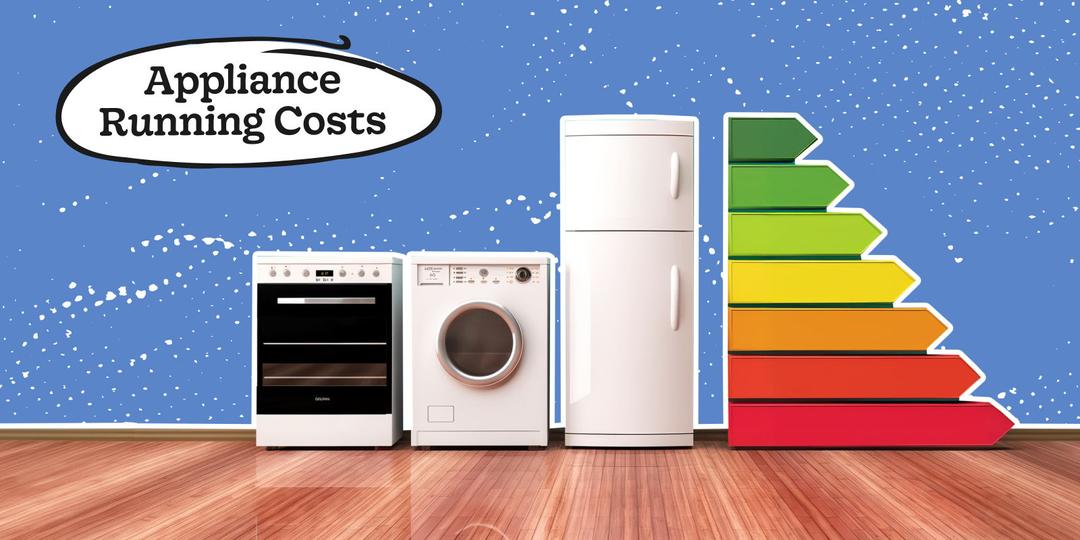

Are you curious to know how much energy your home appliances are using? Potentially allowing you to see where you can make savings and avoid waste?
- How Much Electricity Do Common Household Appliances Use?
- How Much Energy Do Other Household Appliances Use?
- How Much Electricity Does A Desktop Computer (PC) Use?
- How Much Electricity Does A Laptop Use?
- How Much Energy Does a Kettle Use?
- How Much Energy Does a Microwave Use?
- How Much Does a Large Screen TV Use?
- How Much Energy Does a Single Lightbulb Use?
- How Much Energy Does a Tumble Dryer Use?
- How Much Energy Does a Washing Machine Use?
- How Do You Calculate the Amount of Energy Used By An Appliance?
- How Do You Calculate the Energy Cost Of An Appliance?
- Which Appliances Use the Most Energy?
The rising cost of energy has become a significant concern for both the public and the UK Government. Recent figures from the Office for National Statistics (ONS) show that approximately 13% of households are now in fuel poverty, highlighting the growing financial strain on many families.
But what can you do about it? Simply changing your habits without understanding your energy usage won’t necessarily save you money.
A more effective approach begins with understanding how much energy your household appliances consume. By pairing this knowledge with a smart meter, you can identify the devices consuming the most electricity. This insight allows you to monitor and manage your energy usage more effectively.
With this information, you can take steps to reduce energy waste, adopt more energy-efficient practices, and ultimately lower your electricity bills. Not only does this help you save money, but it also contributes to environmental sustainability, benefiting both your wallet and the planet.
Here’s a tip: Many households are now adopting battery storage systems to take advantage of lower off-peak tariffs, which can significantly reduce energy costs. Explore how you can start saving today - click here to learn more!
How Much Electricity Do Common Household Appliances Use?
The energy consumption of an appliance depends on several factors, primarily its size, wattage, and how long it’s used each day. Additionally, electricity prices can vary based on your location within the UK and the tariff you’re on, influenced by changes in the energy price cap, which adjusts periodically.
Other important factors include the age and efficiency of the appliance, the conditions under which it operates, and whether it remains in standby mode when not in use.
For common questions about energy consumption per appliance, we’ll use average figures and real-world examples, working with the latest data on energy prices to give you a clear picture of what to expect.
PS: You can check the history of the energy price cap, along with future estimates, in our timeline of the energy price cap here.
What unit rate are these costs based on?
To keep this clear and current, the costs below use the Ofgem energy price cap (average, Great Britain, paying by Direct Debit) for 1 Jan–31 Mar 2026:
Electricity unit rate: 27.69p/kWh
Electricity standing charge (daily): 54.75p/day (this is separate from usage)
Regional rates vary a bit, and fixed tariffs can be lower (or higher). But this is the best “baseline” for quick comparisons.
Estimated Energy Costs of Common Household Appliances:
How to read this table
“Cost per hour” assumes the appliance is running at/near full power for a full hour.
Many appliances cycle (fridges), or run in bursts (kettles, showers), so your real-world cost is usually lower per hour - but the burst can still be expensive.
Appliance (with average power rating) | Cost per hour | Cost per 10 mins |
Electric shower (9 kW) | £2.49 | 41.5p |
Immersion heater (3 kW) | 83.1 p | 13.8p |
Kettle (3 kW) | 83.1p | 13.8 p |
Tumble Dryer (2.5 kW) | 69.2p | 11.5p |
Electric heater (2.5 kW) | 69.2p | 11.5p |
Oven (2.1 kW) | 58.1p | 9.7p |
Washing machine (2.1 kW) | 58.1p | 9.7p |
Oil-filled radiator (2 kW) | 55.4p | 9.2p |
Hairdryer (2 kW) | 55.4p | 9.2p |
Hob (2 kW) | 55.4p | 9.2p |
Grill (1.5 kW) | 41.5p | 6.9p |
Iron (1.5W) | 41.5p | 6.9p |
Toaster/ Microwave / Mower (1 kW) | 27.7p | 4.6p |
Vacuum cleaner (0.9 kW) | 24.9p | 4.2p |
Dehumidifier (0.5 kW) | 13.8p | 2.3p |
Towel rail (0.45 kW) | 12.5p | 2.1p |
Plasma TV (0.35 kW) | 9.7p | 1.6p |
Fridge-freezer (0.15 kW) | 4.2p | 0.7p |
Electric blanket (0.15 kW) | 4.2p | 0.7p |
Desktop computer (0.14 kW) | 3.9p | 0.6p |
LCD TV/ Console (0.12 kW) | 3.3p | 0.6p |
Laptop (0.05 kW) | 1.4p | 0.2p |
TV Box/DVD player (0.04 kW) | 1.1p | 0.2p |
Extractor fan (0.02 kW) | 0.6p | 0.1p |
Broadband router (0.01 kW) | 0.3p | 0.05p |
💡 Key Notes:
Rates reflect 27.69p/kWh (Ofgem cap average, GB, 1 Jan–31 Mar 2026).
Kettles and showers are short, intense bursts - the “per hour” cost looks scary because it assumes continuous use.
Fridge-freezers cycle on/off; real usage is often ~30–50% of the “always on” assumption (varies by model/room temp).
Figures are estimates for easy comparison - your appliance label/manual will give a better power figure.
How Much Energy Do Other Household Appliances Use?
How Much Electricity Does A Desktop Computer (PC) Use?
A typical desktop computer consumes about 140 watts, which is equivalent to 0.14 kWh per hour.
Running this computer for eight hours a day would consume 1.12 kWh. At a cost of 27.69p per kWh, this would equate to approximately 31.0p per day or about 3.9p per hour.
If you use your computer for work, there’s a good chance you’ve got yourself a net profit.
How Much Electricity Does A Laptop Use?
A typical laptop consumes about 50 watts of electricity, which equates to 0.05 kWh per hour.
Running the laptop for eight hours a day would use 0.4 kWh. At a cost of 27.69p per kWh, this amounts to approximately 11.1p per day to operate the laptop, or about 1.4p per hour.
Please note: the wattage of an appliance does not necessarily mean it will end up using more electricity.
It may be more efficient and complete a cycle or its task more quickly - and may actually end up using less energy than older, less efficient models.
If you are interested in saving money on your energy bills, check out our complete guide here. If you’re not interested in saving money on your energy bills, you’re basically alone.
How Much Energy Does a Kettle Use?
A typical kitchen kettle has a power rating of about 3,000 watts and uses approximately 0.11 kWh to heat 1 litre of water.
Thus, heating 1 litre of water costs:
0.11 kWh × 27.69p/kWh = 3.05p (≈ 3.0p per litre)
For four cups (assuming a cup is about a quarter litre), that’s still roughly 3p for four cups of tea or coffee - assuming you only boil what you need.
How Much Energy Does a Microwave Use?
An average microwave with a power rating of 1,000 watts (or 1 kW) costs 27.69p for an hour of running time.
For a 10-minute duration, the cost would be approximately:
Cost for 10 minutes = 4.6p
So, running a microwave for 10 minutes costs about 4.6p. This highlights that while microwaves are powerful, they’re typically only used for short periods, making them relatively cost-effective.
Of course, most people don’t run the microwave for longer than ten minutes (after which the middle of your food will still be cold).
Energy Help Guides:
How Much Does a Large Screen TV Use?
An LCD TV, which consumes about 120 watts, uses 0.12 kWh per hour. If it’s turned on for 8 hours, it costs about 26.6p per day or approximately 3.3p per hour.
However, if you have a plasma TV, which averages around 350 watts, it consumes 0.35 kWh per hour. Therefore, if it’s turned on for 8 hours a day, it will cost about 77.5p per day or about 9.7p per hour.
How Much Energy Does a Single Lightbulb Use?
AA non-energy-saving 100W light bulb uses around 0.1 kW per hour, which would cost approximately 2.8p an hour to use (at the current unit rate).
That means that ten 100W light bulbs being used at once would require 1 kW, which would cost 27.7p an hour.
It’s for this reason that we recommend using energy-efficient LED light bulbs, as they use a fraction of the electricity and therefore cost much less.
For instance, LED light bulbs have typical wattages of between 4 and 20 watts.
How Much Energy Does a Tumble Dryer Use?
A tumble dryer typically uses around 2.5 kW while it’s actively heating and tumbling.
At the current unit rate, that works out to roughly 69.2p per hour - but in reality, dryers run in cycles, and the exact cost depends on:
load size and dampness
programme length and heat setting
whether it’s a heat-pump model (usually cheaper to run than older vented/condensing types)
How Much Energy Does a Washing Machine Use?
The average washing machine has a power rating of around 2,100 watts (2.1 kW).
At the current electricity price, this works out to about 58.1p per hour or approximately 9.7p for 10 minutes - though real-world cost depends heavily on water temperature and cycle length.
This is still cheaper than hiring a maid to wash your clothes by hand.
How Do You Calculate the Amount of Energy Used By An Appliance?
You use the following formula to calculate the energy used by an appliance:
Power rating in kilowatts x hours used per day = kWh per day.
Recommended reading:
How Do You Calculate the Energy Cost Of An Appliance?
You use the following formula to calculate the energy cost of an appliance:
kWh per day × unit cost = cost of electricity each day
For example:
If you had a 500W (0.5 kW) appliance and operated it for the entire day (24 hours), it would use:
0.5 kW × 24 hours = 12 kWh
Given the current electricity unit rate of 27.69p/kWh, multiplying 12 kWh by 27.69p results in a total of 332.3p, or £3.32.
As mentioned previously, we used the latest price cap unit rate. However, since energy prices can fluctuate, it’s important to update these figures at regular intervals.
Which Appliances Use the Most Energy?
The general rule is that the appliances that have more moving parts use the most energy, for example, tumble dryers, washing machines and microwaves.
In fact, the Energy Saving Trust breaks down the most energy-consuming appliances into five distinct categories:
Wet appliances – use 16% of total energy bill costs.
Cold appliances – use 12% of total energy bill costs.
Consumer electronics – use 7% of total energy bill costs.
Lighting – use 6% of total energy costs.
Cooking – use 4% of total energy costs.
Note that your kids demand a lot of energy, but it can’t be expressed in kWh (until you start to dry their clothes).
Related reading:
Methodology:
We use the Ofgem electricity price cap unit rate for the current cap period (1 Jan–31 Mar 2026): 27.69p/kWh.
To determine how much it costs to run an appliance:
1. Calculate energy used: Power (kW) × hours used = kWh
2. Calculate cost: kWh × unit rate = cost
Example:
If you have a 500W (0.5 kW) appliance and you run it for a whole day (24 hours), it will use 12 kWh of electricity.
If your electricity costs 27.69p per unit, then multiply 12 kWh by 27.69p and you get a grand total of 332.3p, or £3.32.